Cricket and baseball look like cousins. Both feature a bat and ball, a pitcher or bowler, fielders in a wide arc and a batter trying to hit and run. Both also belong to the family of bat-and-ball games, and many of their ideas come from older English pastimes such as rounders.
Yet once you start watching, the differences stand out. One sport has a diamond, the other an oval with a central pitch. One has foul territory, the other lets batters hit in any direction. One ends in three hours, the other can run for five days. This guide compares the rules, equipment, scoring and strategy of the two sports so that fans from either side of the Atlantic can understand the other.
Shared Roots
Baseball and cricket are generally considered distant relatives, with ancestors in older English bat-and-ball games. Baseball took shape in the United States in the nineteenth century and developed its own rules, while cricket was codified in England and spread through the British Empire.
That shared origin explains the similarities: a pitched or bowled ball, a batter, fielders and runs. But the games went in separate directions, and their rules now produce very different matches.
Quick Comparison
| Feature | Cricket | Baseball |
|---|---|---|
| Players per side | 11 | 9 |
| Playing area | Oval field with central pitch | Diamond-shaped infield with outfield |
| Hitting area | 360 degrees | 90-degree fair territory |
| Bat shape | Flat-faced | Round |
| Delivery | Bowled with straight arm, often bouncing | Pitched overhand, usually without bouncing |
| Dismissal | 10 wickets per innings | 3 outs per half-inning |
| Match length | Hours to five days | About 3 hours |
| Scoring | Runs between wickets, 4s, 6s | Runs by completing the bases, home runs |
The Field
Cricket
A cricket field is a large oval with no fixed size, though there is a boundary rope. In the centre is a 22-yard pitch, with a set of stumps (the wicket) at each end. The action occurs along this strip, but fielders can be positioned anywhere around the oval.
Baseball
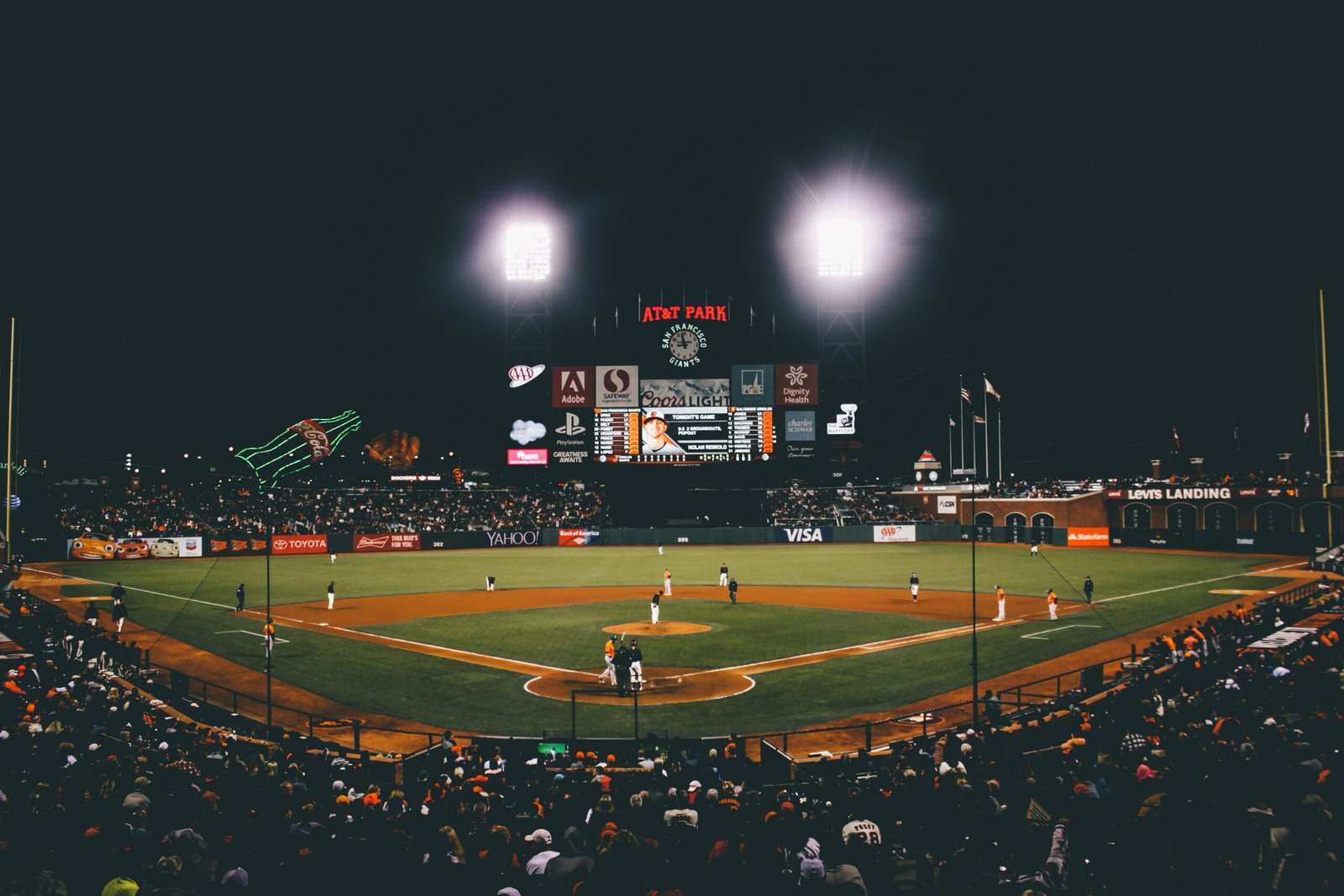
A baseball field has a diamond-shaped infield with four bases, 90 feet apart, and a larger outfield. A fence or wall marks the boundary. The area where the ball can legally be hit, known as fair territory, covers a 90-degree angle from home plate. Anything outside that is a foul ball.
This is one of the biggest differences. In cricket, a batter can hit the ball in any direction, including backwards, and score. In baseball, hits must land within the fair area.
The Bat
A cricket bat is flat on one side and designed for hitting a ball that has often bounced on the pitch. Bats are made from willow, with a flat face and a ridge on the back.
A baseball bat is cylindrical and generally made of wood (such as maple or ash) in professional games. Its round shape suits hitting a ball that arrives in the air.
Delivering the Ball
Bowling in Cricket
In cricket, the bowler delivers the ball with a straight arm, which limits how it can be thrown. Most deliveries bounce once on the pitch before reaching the batter, and bowlers vary pace, spin and swing to beat the bat. Fast bowlers can deliver the ball at speeds comparable to a baseball fastball.
Each set of six legal deliveries is called an over, after which a different bowler takes over from the other end.
Pitching in Baseball
A baseball pitcher stands on a mound and throws overhand, usually without a bounce. Pitchers mix fastballs, curveballs, sliders and changeups to disrupt the batter’s timing. A batter gets a limited number of strikes: three strikes, and the batter is out. Four balls (pitches outside the strike zone) result in a walk to first base.
Major League Baseball introduced a pitch clock in 2023 to speed up games, one of the sport’s biggest rule changes in recent years.
Batting and Running
Cricket
Two batters are on the field at once, one at each end of the pitch. When the batter hits the ball, they may run to the other end, swapping places with their partner. Each completed run scores one. They do not have to run: batters can leave the ball and wait for a better delivery.
Batters can remain at the crease for a long time, potentially hours, scoring runs steadily. A single batter can score a century (100 runs) or more.
Baseball
One batter faces the pitcher at a time. After hitting a fair ball, the batter becomes a runner and tries to reach first base. Runners must touch each base in order, and they can be put out by tagging or forcing them at a base.
Batters can also be walked, hit by a pitch or struck out.
How Scoring Works
Cricket Scoring
Runs come from:
- Running between the wickets (one run per length of the pitch)
- Boundaries: four runs if the ball reaches the boundary after bouncing, six if it clears it on the full
- Extras: wides, no-balls, byes and leg byes
For more detail on scoring, see our beginner’s guide to how cricket works.
Baseball Scoring
A run is scored when a runner touches all four bases and reaches home plate. A home run, where the ball is hit over the outfield fence in fair territory, allows the batter and any runners on base to score. A grand slam, with bases loaded, scores four runs.
Baseball scores tend to be lower than cricket’s totals, but the pattern of scoring is steady, with games often decided by a few key moments.
Getting Out
Cricket Dismissals
There are several ways to be out, including:
- Bowled
- Caught
- Leg before wicket (LBW)
- Run out
- Stumped
A cricket team’s innings ends after 10 batters are out, or when overs run out in limited-overs formats.
Baseball Outs
A batter can be put out by:
- Striking out
- Flying out (the ball is caught before it hits the ground)
- Grounding out (the ball is fielded and thrown to first base before the batter arrives)
- Being tagged or forced out on the bases
A half-inning ends after three outs, so teams alternate rapidly.
Match Structure
Cricket Formats
Cricket’s three main formats vary dramatically:
- Test cricket: up to five days, each side batting twice.
- One Day Internationals (ODIs): 50 overs per side.
- Twenty20 (T20): 20 overs per side, lasting around three hours.
Baseball Games
A baseball game consists of nine innings. Each inning has a top half (the visiting team bats) and a bottom half (the home team bats). If the score is tied after nine innings, extra innings are played until one team leads. MLB uses an automatic runner on second base in extra innings to shorten games.
A baseball game cannot end in a draw (barring rare exceptions such as weather), while a Test cricket match can.
Strategy and Tempo
Both sports involve a lot of tactics, but the focus is different.
In cricket, bowlers and captains think in terms of building pressure, setting fields and removing batters over long periods. In baseball, managers use relief pitchers, defensive shifts, pinch hitters and base-running decisions to gain small advantages.
Cricket in its longer forms is about endurance and patience. Baseball is paced around individual moments: the pitcher against the batter, the runner on first, the double play.
Fielding
Cricket has no gloves for fielders, apart from the wicketkeeper, who wears gloves and pads. Fielders are positioned in locations such as slip, cover and mid-wicket, and they cannot be restricted by foul territory.
Baseball fielders all wear gloves, and positions are fixed around the diamond: pitcher, catcher, first base, second base, shortstop, third base and three outfielders. The catcher plays a role similar to the cricket wicketkeeper.
Equipment and Protection
Cricket batters wear pads, gloves, helmets and often thigh guards and arm guards. Baseball batters wear helmets, and catchers wear heavy protective gear.
Statistics
Both sports love numbers. In cricket, batting average, strike rate and bowling economy are common. In baseball, batting average, on-base percentage, earned run average and home runs are standard measures. The two sports’ statistical cultures have influenced analytics and fan engagement in each country.
Global Reach
Cricket is hugely popular across South Asia, Australia, England, the Caribbean and parts of Africa. Baseball is dominant in the United States, Japan, South Korea, Cuba and the Dominican Republic, and is widely followed in Latin America.
The two sports will both feature at the Los Angeles 2028 Olympics, with cricket returning in a T20 format.
Which Is Easier to Learn?
Many newcomers find baseball more straightforward at first because the field layout and rules about balls and strikes are easy to follow. Cricket’s variety of formats, scoring methods and terminology can take longer to understand.
On the other hand, cricket’s central idea, bat the ball and run, is simple, and T20 matches offer a quick introduction.
Conclusion
Cricket and baseball are related but distinct. Cricket uses a flat bat, a central pitch and a 360-degree hitting area, with matches that can last from hours to days. Baseball uses a round bat, a diamond and fair and foul territory, with games usually lasting around three hours.
Neither is better than the other. Each rewards skill, patience and strategy in different ways. If you grew up with one, the other may feel unfamiliar, but understanding the differences makes watching both far more rewarding. A single T20 match and a single baseball game is often all it takes to see why fans love their sport.