American football can look like organised chaos to a newcomer. Twenty-two huge athletes collide, a whistle blows, and then everyone walks back to start again. Yet underneath is a logical, strategic game built on a few simple ideas: advance the ball, score points and stop the other team from doing the same.
This guide explains how the game works from first principles. You will learn the basic objective, how downs and yardage work, what each position does, how points are scored and which penalties come up most often. It also covers how the NFL season and playoffs are structured, so you can follow a game or a Super Bowl with confidence.
The Basic Objective
Two teams of 11 players on the field try to move an oval ball into the opponent’s end zone, or kick it through the goalposts. The team with more points at the end of four quarters wins.
The game is played on a rectangular field 100 yards long, with a 10-yard end zone at each end. Yard lines are marked every five yards, and the hash marks and numbers help players, officials and viewers track progress.
A professional game is divided into four 15-minute quarters, with a break at halftime. Because the clock stops frequently, a game usually lasts around three hours of real time.
Offence, Defence and Special Teams
The roster is split into three units:
- Offence: has the ball and tries to score.
- Defence: tries to stop the offence and take the ball away.
- Special teams: handle kickoffs, punts, field goals and returns.
Substitutions are unlimited, so players specialise. In the NFL, teams carry 53 players on the roster, and a smaller group is active on game day.
Downs and Yardage: The Heart of the Game
The most important concept is the down system.
- The offence has four attempts (downs) to advance the ball at least 10 yards.
- If it succeeds, it earns a first down: a fresh set of four attempts.
- If it fails after four downs, the ball goes to the other team.
Most teams do not use all four downs. On fourth down, they typically punt (kick the ball away to push the opponent back) or attempt a field goal. Occasionally, teams “go for it” on fourth down if they are close to the target distance or need to take a risk.
This system creates constant strategy. A coach must decide on every down whether to run, pass, kick or gamble.
How a Play Works
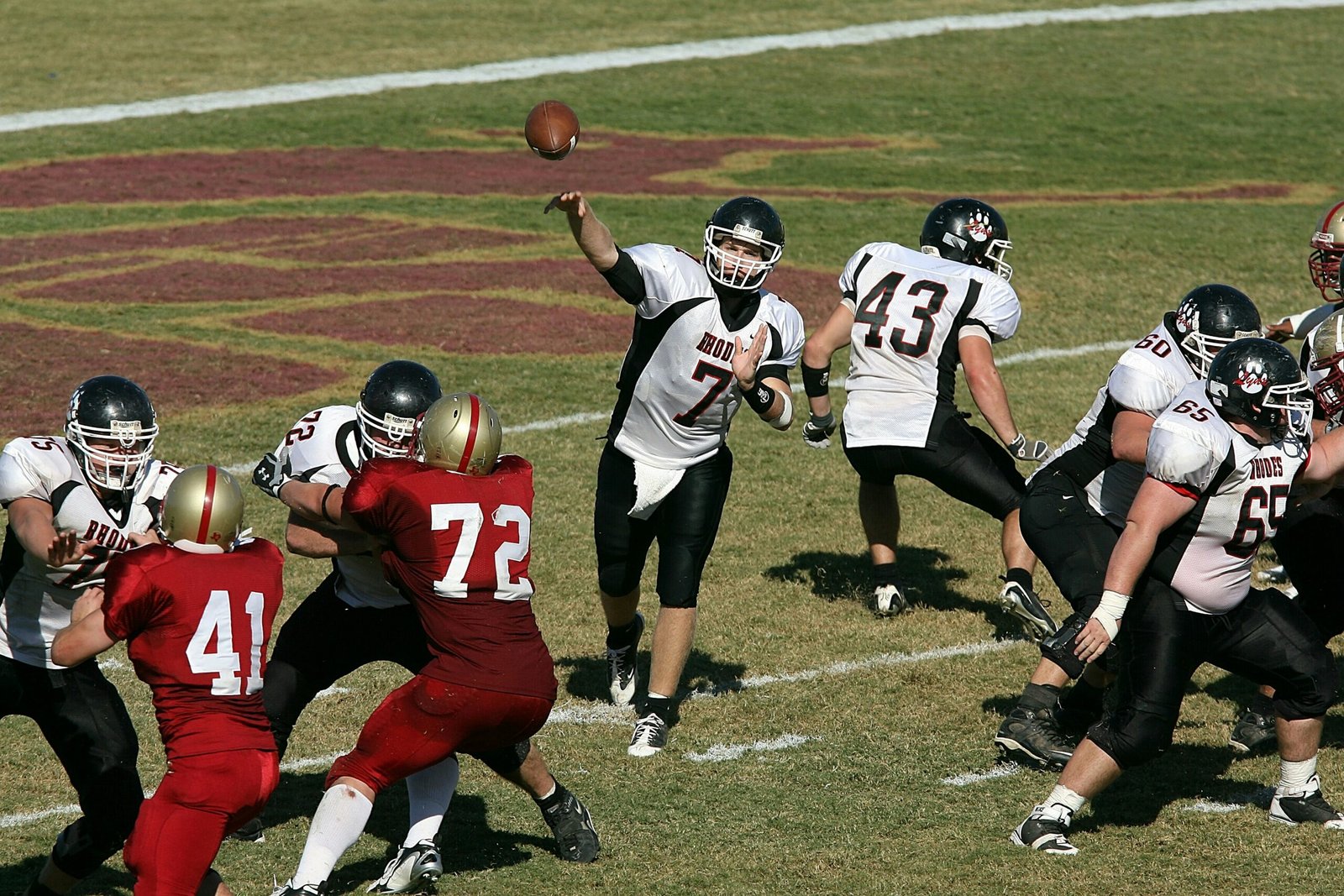
Each play begins at the line of scrimmage, an imaginary line where the ball is placed. The offence lines up on one side, the defence on the other. The centre snaps the ball to the quarterback, and the play begins.
A play ends when:
- The ball carrier is tackled or goes out of bounds.
- A forward pass hits the ground (an incomplete pass).
- A score occurs.
After each play, teams reset, and the clock may stop or keep running depending on the situation. Teams have a limited time, known as the play clock, to start the next play.
The Main Ways to Advance the Ball
Running Plays
The quarterback hands or tosses the ball to a running back, who tries to gain yards on the ground. Running plays are lower risk, keep the clock moving and help wear down the defence.
Passing Plays
The quarterback throws the ball forward to a receiver. Only one forward pass is allowed per play, and it must be thrown from behind the line of scrimmage. Passing plays can gain large chunks of yardage but risk incompletions or interceptions.
The Positions Explained
Offence
- Quarterback (QB): the leader of the offence. He calls plays, throws passes and sometimes runs.
- Running back (RB): carries the ball, catches passes and blocks.
- Wide receiver (WR): runs routes to catch passes. Teams often use three at a time.
- Tight end (TE): a hybrid player who blocks like a lineman and catches like a receiver.
- Offensive line (OL): five players, including the centre, who protect the quarterback and open space for runners.
Defence
- Defensive line (DL): players who rush the quarterback and stop runs.
- Linebackers (LB): versatile players who tackle runners, rush the passer and cover receivers.
- Cornerbacks (CB): cover wide receivers and try to prevent catches.
- Safeties (S): the last line of defence, covering deep passes and supporting against the run.
Special Teams
- Kicker (K): takes field goals, extra points and kickoffs.
- Punter (P): kicks the ball away on fourth down to gain field position.
- Returners: catch kicks and punts and try to run them back.
- Long snapper and holder: specialists who set up kicks.
How Points Are Scored
| Scoring Play | Points | How It Happens |
|---|---|---|
| Touchdown | 6 | Carrying or catching the ball in the opponent’s end zone |
| Extra point (PAT) | 1 | Kick through the uprights after a touchdown |
| Two-point conversion | 2 | Running or passing into the end zone from short range after a touchdown |
| Field goal | 3 | Kicking the ball through the uprights during play |
| Safety | 2 | Tackling an opposing ball carrier in their own end zone |
A touchdown followed by an extra point is the most common scoring combination, worth seven points. That is why you will often hear commentators talk about a “one-score game” or a “two-score game” in terms of seven and fourteen points.
Turnovers
A turnover happens when the offence loses possession without punting. The two main types are:
- Interception: a defender catches a pass intended for a receiver.
- Fumble: the ball carrier drops the ball, and the defence recovers it.
Turnovers can swing games dramatically, which is why teams coach ball security so intensely.
Common Penalties
Officials throw yellow flags to signal rule violations. Common penalties include:
- False start: an offensive player moves before the snap (5 yards).
- Offside: a defender is across the line of scrimmage when the ball is snapped (5 yards).
- Holding: illegally grabbing or restraining an opponent (10 yards on offence, 5 yards and an automatic first down on defence).
- Pass interference: illegally making contact with a receiver before the ball arrives, which can result in a large gain of yards for the offended team.
- Roughing the passer: hitting the quarterback illegally (15 yards and an automatic first down).
- Delay of game: failing to start the play before the clock expires (5 yards).
The captain of the offended team can usually choose to accept or decline a penalty, depending on how the play ended.
Kickoffs, Punts and Field Position
A game begins with a kickoff, and kickoffs also follow scores. The NFL has adjusted its kickoff rules in recent seasons to reduce injuries, including a restructured format introduced in 2024 and further changes for 2025, so check the league’s latest rulebook for the current version.
Field position matters enormously. A team starting on its own 20-yard line has a long way to go, while one starting near midfield has a short field. This is why punting and returns carry strategic weight.
Overtime
If the score is tied at the end of regulation in a regular-season game, the NFL plays an overtime period of up to 10 minutes. Playoff games continue until there is a winner, with extra periods if needed. Overtime rules have been revised several times, and in recent seasons both teams have been guaranteed a possession in more situations. The league’s official rulebook has the latest details.
Replay and Challenges
Every scoring play is automatically reviewed. Head coaches can also challenge certain calls, such as whether a pass was caught or whether a player was down, by throwing a red flag, though they have a limited number of challenges per game. Officials review the play on a monitor and decide whether to overturn the call.
The NFL Structure
Teams and Conferences
The NFL has 32 teams, split into two conferences: the American Football Conference (AFC) and the National Football Conference (NFC). Each conference has four divisions of four teams.
The Regular Season
Teams play 17 regular-season games over 18 weeks, with one bye week each. The season typically begins in early September, and the schedule includes a mix of divisional and non-divisional opponents.
The Playoffs
Seven teams from each conference reach the playoffs: the four division winners and three wild cards. The top seed in each conference receives a first-round bye. The knockout rounds are single-elimination games: wild card, divisional, conference championships, and finally the Super Bowl.
The Super Bowl
The Super Bowl is the NFL’s championship game, played each February at a neutral site. It is one of the most-watched television events in the United States each year and has a reputation for its halftime show and its commercials, alongside the football itself.
How to Follow Your First Game
- Watch the line of scrimmage. The battle between the offensive and defensive lines often decides games.
- Track the down and distance. Phrases like “third and six” mean the offence is on its third attempt and needs six more yards.
- Look for the quarterback. Understand how the quarterback reads the defence and chooses where to throw.
- Listen to the commentary. US broadcasts often include former players who explain strategy, and replays highlight key matchups.
- Pick a team. Following one side makes the rules and rhythm far easier to learn.
American Football vs Other Sports
If you are coming from rugby or football, American football’s stop-start nature can feel surprising. Our guide to rugby and American football compares the two in detail. The key differences include the forward pass, the down system and unlimited substitutions.
Conclusion
American football is complex, but the underlying logic is straightforward. The offence has four downs to gain 10 yards, the defence tries to stop it, and points come from touchdowns, field goals and a few other scoring plays. Each of the positions has a specific job, and the pauses between plays exist so teams can plan their next move.
Once you understand downs, scoring and the main positions, you can follow most of what happens on the field. The best way to deepen your understanding is to watch a few games, ideally with a friend who already knows the sport. Before long, the strategy beneath the collisions starts to become clear.